


Londres En Poche Et Ses Environs
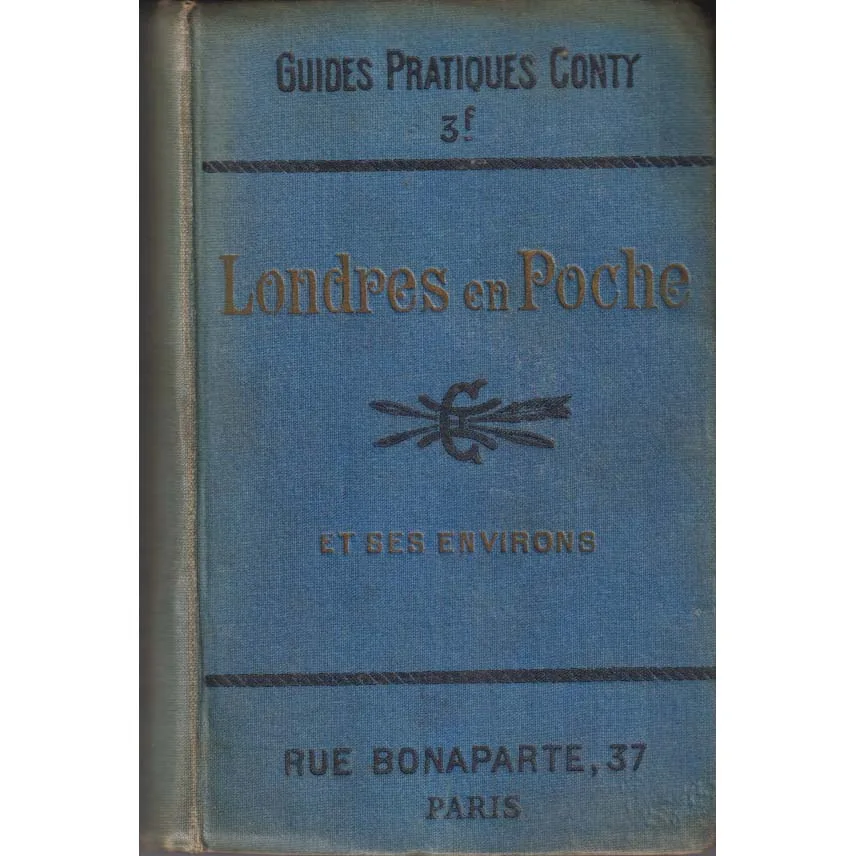
Publisher: Administration des Guides Conty
Format: Paperback
ISBN: none
Londres en Poche et ses Environs (1909) by Guides Pratiques Conty – E. et J. Le Brun – Administration des Guides Conty – Good Condition – French Language – Folding Map Missing
Long before Google Maps, TripAdvisor, Oyster cards, online reviews and the comforting little blue dot that tells you where you have accidentally wandered, visitors to London had another option:
a small book.
Londres en Poche et ses Environs, published in 1909 by Guides Pratiques Conty under E. et J. Le Brun, is a French-language pocket guide to London and its surroundings from the final years of the Edwardian era — a time when tourists navigated the capital with printed directions, railway timetables, hotel recommendations and considerably more confidence in their own sense of direction than most of us would now consider advisable.
The title literally promises “London in Your Pocket and its Environs”, which is ambitious considering London was already quite large in 1909 and had not shown any obvious intention of becoming more manageable.
Designed for French-speaking visitors, the guide offers a fascinating period view of Britain’s capital as it was presented to continental travellers more than a century ago. This is London before skyscrapers, before Heathrow, before the Underground map acquired its famous modern form and before anyone had to explain why a coffee near a railway station costs more than lunch once did.
The London encountered here is one of horse traffic alongside motor cars, railway termini, grand hotels, theatres, museums, monuments, parks, shopping streets and the immense machinery of the British Empire still operating at something close to full confidence.
For the modern reader, that makes the book much more than an obsolete travel guide.
It is a little time capsule.
Places which remain instantly recognisable sit beside businesses, routes, customs and assumptions that have long disappeared. Attractions described as essential may now be forgotten. Journey times, prices and practical advice belong to an age when international tourists arrived with trunks rather than wheelie cases and when “nearby” might involve considerably more walking than modern visitors have been trained to tolerate.
There is also something especially appealing about seeing London through French eyes.
The book was not written primarily for Londoners explaining their own city to themselves, but for visitors arriving from across the Channel. The result offers a glimpse of what publishers thought a French traveller needed to know about Britain: where to go, what to see, how to travel and presumably how to survive the peculiarities of English life with dignity intact.
One imagines the visitor arriving with this guide tucked safely into a coat pocket, ready to confront London armed with practical French instructions and perhaps a mild suspicion regarding the food.
This particular copy is in Good condition, which is impressive enough for a travel guide published in 1909. Pocket guides tend to have difficult lives. They are carried, folded, consulted in the rain, stuffed into luggage, dropped in railway carriages and generally treated as working equipment rather than precious literature.
There is, however, one important omission.
The book originally contained a large folding map of London housed in a pouch at the rear, and that map is missing.
So the guide remains.
The map has gone exploring on its own.
Quite where it went is impossible to say. Perhaps it was removed by a tourist in 1912 and never returned. Perhaps it became detached somewhere between Victoria and the British Museum. Perhaps it has spent the last hundred years folded inside another book. Old maps have a remarkable ability to achieve independent lives.
The missing map should therefore be noted by collectors seeking a complete example, but the surviving book remains a fascinating piece of Edwardian travel history, particularly for anyone interested in London, vintage tourism, French travel literature or the extraordinary quantity of practical information once compressed into pocket guides.
There is no ISBN, because in 1909 ISBNs were still more than half a century away and travellers somehow managed to purchase books without barcodes, QR codes, online listings or being asked whether they would also like to subscribe to the publisher’s newsletter.
Ideal for collectors of antique travel guides, London enthusiasts, Francophiles, historians of tourism, railway and transport collectors, or anyone interested in discovering how a French visitor was expected to navigate Edwardian London without satellite assistance.
Also suitable for the historically adventurous reader who would like to follow a 1909 guide around modern London and see how many recommended establishments have survived.
Just bring your own map.
Sold by Crappy Old Books — where London still fits in your pocket, the French remains intact, and the folding map has unfortunately already left for the Continent.
Keep browsing: See more French books Other books by Guides Pratiques Conty - E et J Le Brun
